
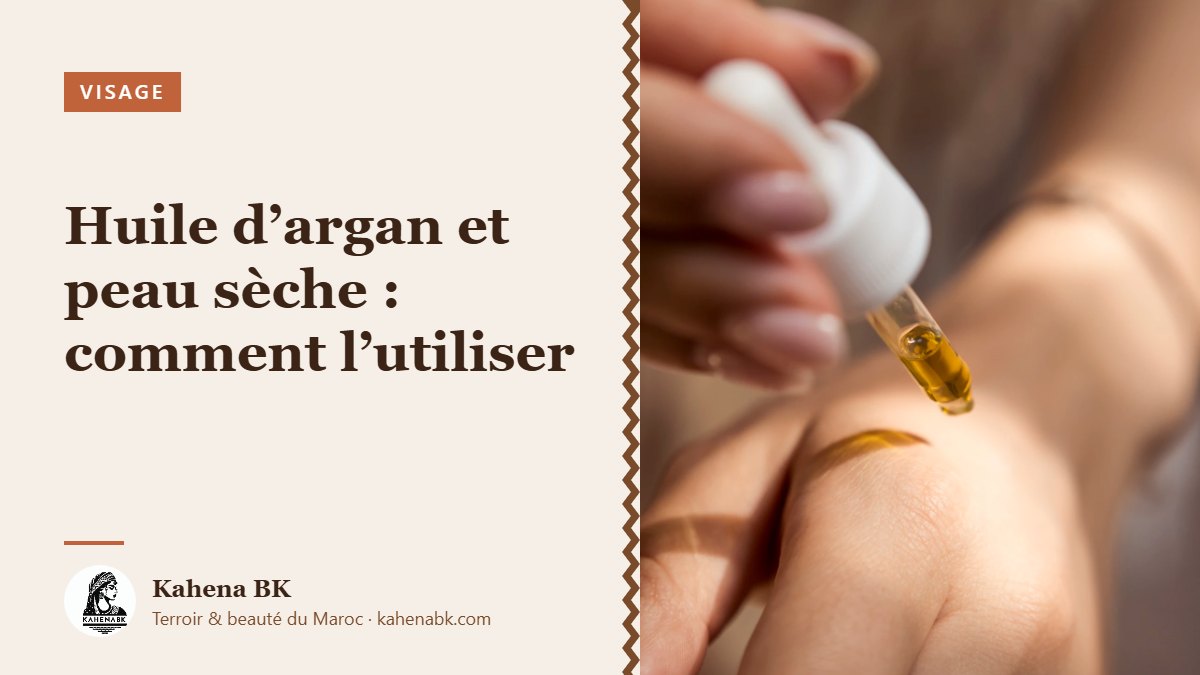
Une peau sèche manque de lipides : sa barrière protectrice est moins efficace, l’eau s’évapore plus vite, et la peau tiraille, rougit ou pèle. L’huile d’argan fait partie des soins les plus simples pour lui redonner du confort. Voici comment l’utiliser correctement.
Peau sèche ou peau déshydratée ?
La peau sèche est un type de peau : elle produit peu de sébum, en permanence. La peau déshydratée est un état passager : elle manque d’eau, quel que soit son type (même une peau grasse peut l’être). Les deux se soignent différemment : la peau sèche a besoin de corps gras, la peau déshydratée d’abord d’eau. Si vous hésitez, lisez huile d’argan et peau déshydratée.
Pourquoi l’huile d’argan convient aux peaux sèches
Composée majoritairement d’acides gras insaturés, elle complète le film lipidique de la peau et limite la perte d’eau. Résultat : une peau plus souple, moins rugueuse, plus confortable au fil des jours. Elle n’apporte pas d’eau en elle-même, d’où l’importance de l’appliquer sur une peau humide.
La bonne méthode pour le visage
- Nettoyez avec un produit doux, sans savon décapant.
- Vaporisez une eau florale (eau de rose) ou appliquez un sérum hydratant, comme notre sérum acide hyaluronique & argan.
- Sur peau encore humide, appliquez 2 à 3 gouttes d’huile d’argan par pressions.
- Le matin, préférez une crème : notre crème d’argan pour peau sèche contient 40 % d’huile d’argan.
- Terminez toujours par une protection solaire le matin.
Et pour le corps
Juste après la douche, sans vous sécher complètement, massez l’huile ou un lait corporel sur les zones les plus sèches : tibias, coudes, genoux, talons. Évitez les douches trop chaudes et trop longues, qui dessèchent la peau.
Les gestes qui aggravent la sécheresse
- L’eau très chaude et les savons décapants.
- Les gommages trop fréquents (une fois par semaine maximum, et doux).
- Les produits parfumés ou alcoolisés.
- Le chauffage et la climatisation sans humidification.
Quand consulter ?
Si la peau reste sèche malgré une routine adaptée, démange beaucoup, se fissure ou présente des plaques rouges, consultez un médecin ou un dermatologue : il peut s’agir d’un eczéma ou d’une autre affection qui demande un traitement.
Combien de gouttes d’huile d’argan sur le visage ?
2 à 3 gouttes suffisent pour tout le visage. Au-delà, la peau brille sans être mieux nourrie.
Matin ou soir ?
Le soir de préférence. Le matin, une goutte mélangée à la crème suffit, sous l’écran solaire.
L’huile d’argan peut-elle boucher les pores ?
Elle est considérée comme peu comédogène. Sur une peau à tendance acnéique, testez-la quelques semaines et arrêtez si des boutons apparaissent.
Quel soin pour vous ?
Répondez à 6 questions dans notre diagnostic beauté gratuit : nous vous indiquons le soin ou le pack de notre gamme le plus adapté.
Laisser un commentaire